How to Choose a HOWO Dump Truck Body: Steel Thickness, Volume, and Material Match
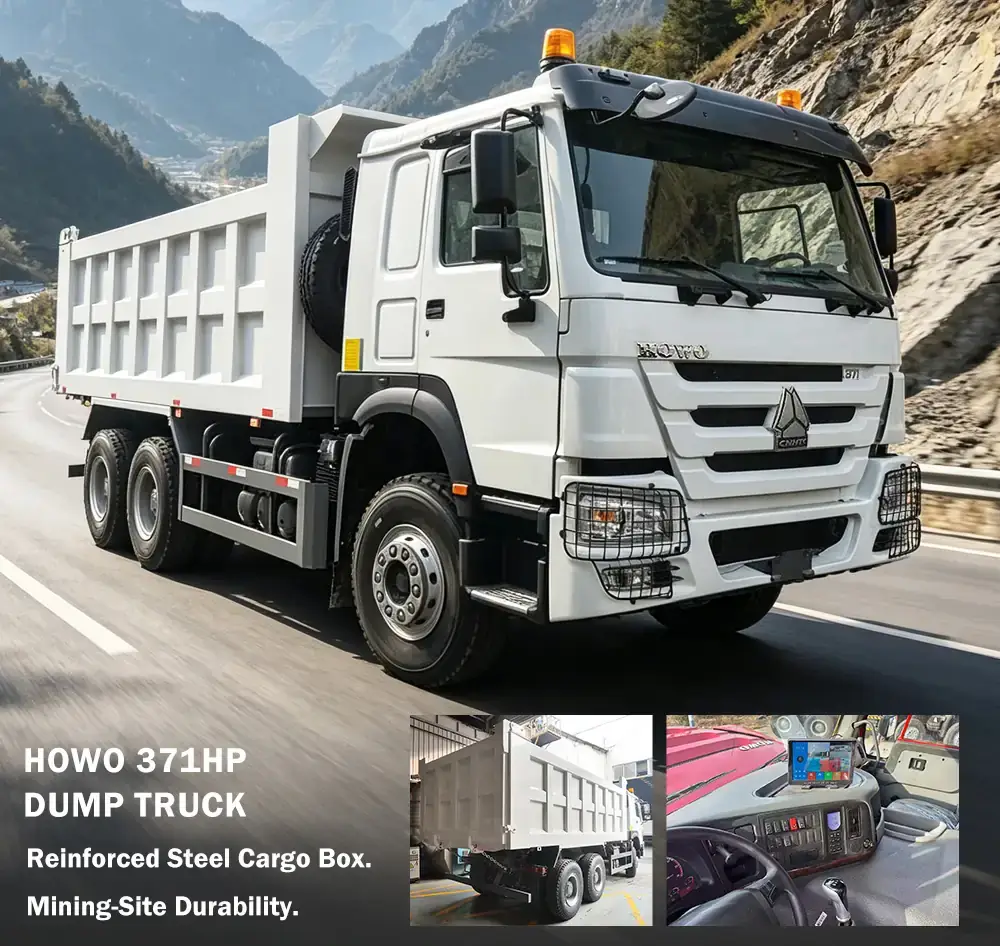
Why the Body Specification Drives Long-Term Cost
The engine and chassis are built to last the life of the truck. The cargo body is different — it is a wearing surface, closer to a consumable. Every load cycle delivers a fresh impact to the floor and a fresh scrape to the sides. When a body reaches the end of its life, the options are welding patch plates, rebuilding the floor and sides, or full replacement — all expensive, and the downtime often costs more than the work itself. Specifying correctly at purchase defers that first major body intervention by years.
Decision 1: Steel Thickness
A dump body is built from plate in two zones, usually at different thicknesses:
Floor plate — the thicker of the two. The floor takes the direct impact of dropped material plus the abrasive sliding load during discharge. It fails first in most bodies.
Side and front plates — thinner. They resist lateral pressure and abrasion, but not the same vertical impact.
For reference, a HOWO dump truck body in heavy-duty mining specification is commonly built with a Q345B high-tensile steel floor around 8 mm and side plates around 6 mm — a robust spec intended for continuous loading of hard rock, ore, and overburden. It is the specification for the most demanding duty, not the only correct one.
Thickness follows from three factors: material hardness and abrasiveness (sharp rock cuts steel far faster than sand or soil), loading height and method (an excavator dropping boulders from height imposes far more impact than a loader pushing material in from ground level), and loading frequency (40 cycles a day wears a body far faster than 10).
One caution: more steel means more weight, and body weight counts against legal payload. A heavier body than the duty requires does not meaningfully improve durability — it permanently reduces the payload you can carry. Match thickness to actual conditions, not to a habit of "going heavy for safety."
Decision 2: Volume — Match to Material Density, Not to a Bigger Number
This is where the most expensive errors happen. Buyers assume a larger body is better because it looks like more capacity. In practice, correct body volume is determined by material density.
Payload is density multiplied by volume. A body right for one material can be badly wrong for another:
Dense material (iron ore, wet clay, heavy rock): reaches legal payload at a small volume. If the body is sized for light material, the truck is legally overloaded before the body looks full — every trip is an overload trip, accelerating wear on axles, springs, brakes, and frame.
Light material (coal, dry aggregate): fills the volume long before reaching legal payload. If the body is sized for dense material, the truck runs under-loaded on every trip — an economic loss multiplied across annual tonnage.
HOWO bodies are commonly offered in the 18 to 22 cubic metre range and are customizable. Work backwards from your operation:
Identify the material you haul most often.
Establish its density in tonnes per cubic metre — confirm this for your specific material rather than assuming.
Multiply density by candidate volumes to find the one that lands at your target payload.
Check that payload against legal gross weight and axle ratings in your market.
Confirm the resulting body dimensions fit the truck's wheelbase and overall length.
If you haul multiple materials, size for the most common one and accept that some loads will be volume-limited rather than weight-limited.
Decision 3: Material Match — Steel Grade and Body Shape
Steel grade
Q345B carbon steel (high-tensile): the standard HOWO body specification. A good balance of strength, toughness, and weldability at moderate cost. Right for sand, gravel, earth, and most construction materials.
Wear-resistant (abrasion-resistant) steel: harder plate that resists gouging and abrasion far better. The choice for continuous hard-rock and ore haulage, where Q345B floor would thin out within a few thousand hours. Costs more and requires more demanding welding.
Stainless steel: reserved for corrosive or high-hygiene materials, not routine earthmoving. Adds cost without a durability benefit in abrasive-but-non-corrosive work.
The governing question is abrasiveness, not price. A body that wears through in two years costs more in rebuilds and downtime than the price difference of harder steel. Equally, paying for abrasion-resistant plate to haul soft soil returns nothing.
Body shape
HOWO bodies are commonly built in a U-shape profile. The rounded section promotes clean discharge (material is less likely to stick in corners) and distributes stress more evenly than a rectangular box, resisting the deformation that develops at corner welds over time. Rectangular bodies offer slightly more volume within the same outer dimensions, but the U-shape's discharge and stress advantages usually outweigh that in abrasive-material work.
Hydraulic lifting system
Front-lifting: a long-stroke cylinder toward the front of the body. High lifting force, suits longer and heavier bodies, stable for high-tonnage work. The usual choice for heavy mining and construction haulage.
Middle-lifting: a shorter cylinder under the mid-section. Simpler and cheaper; suits shorter bodies and lighter duty.
Sticky materials that resist discharge benefit from the greater lift force of a front-lift system; free-flowing materials in a smaller body may do fine with middle-lift.
Specification Checklist
Material hauled and its density in tonnes per cubic metre
Daily tonnage target and payload per trip
Legal gross weight and axle weight limits in your market
Loading method (excavator or loader) and drop height
Material abrasiveness; whether it sticks or flows during discharge
Road surfaces the truck will operate on
Load cycles per day
Floor and side plate thickness matched to material and loading method
Steel grade — Q345B or abrasion-resistant — matched to abrasiveness
Body volume matched to density and legal payload
Body shape — U-shape or rectangular — selected for discharge and durability
Hydraulic lifting type — front-lift or middle-lift — matched to body size and material
Conclusion
Choosing a HOWO dump truck body comes down to three questions. How thick should the steel be? That follows from material hardness, loading method, and drop height — with the caution that thicker reduces legal payload. How much volume should it hold? That follows from material density, working backwards from your target payload so the truck is neither overloaded nor under-loaded. What should it be made of, and what shape? That follows from abrasiveness and discharge behaviour — Q345B U-shape for most construction materials, abrasion-resistant plate where hard rock and ore are hauled continuously. Answer these with your own operating data rather than by comparing brochures, and the body will deliver the service life that keeps the truck profitable.
For body customization — plate thickness, steel grade, volume, and lifting configuration — on HOWO dump trucks, contact the Shandong Chengda Auto Sales team.