African Mining Expansion and the Demand for Heavy Dump Trucks
Why Mining Expansion Drives Dump Truck Demand
The relationship between mining activity and heavy truck demand is more direct than in most industries. Mining is, at its core, a materials movement business. Ore must be extracted from the pit or underground, hauled to a processing plant or stockpile, and moved again as waste rock and overburden are stripped away to expose the deposit. Every stage of that process depends on trucks.
When a mining operation expands — a new pit opened, an existing pit deepened, a processing plant capacity increased — the volume of material to be moved rises, and so does the number of trucks required. Unlike many industrial equipment purchases, this demand does not wait for existing fleets to wear out. New phases of a project need additional trucks, and they need them on a schedule tied to the project's construction timeline.
There is a second layer to the demand. Mining projects in remote regions often build or upgrade the access roads, haul roads, and supporting infrastructure that serve the site. That construction work generates its own demand for dump trucks — for moving aggregate, building road base, and clearing and earthmoving works — even before the mine itself begins production.
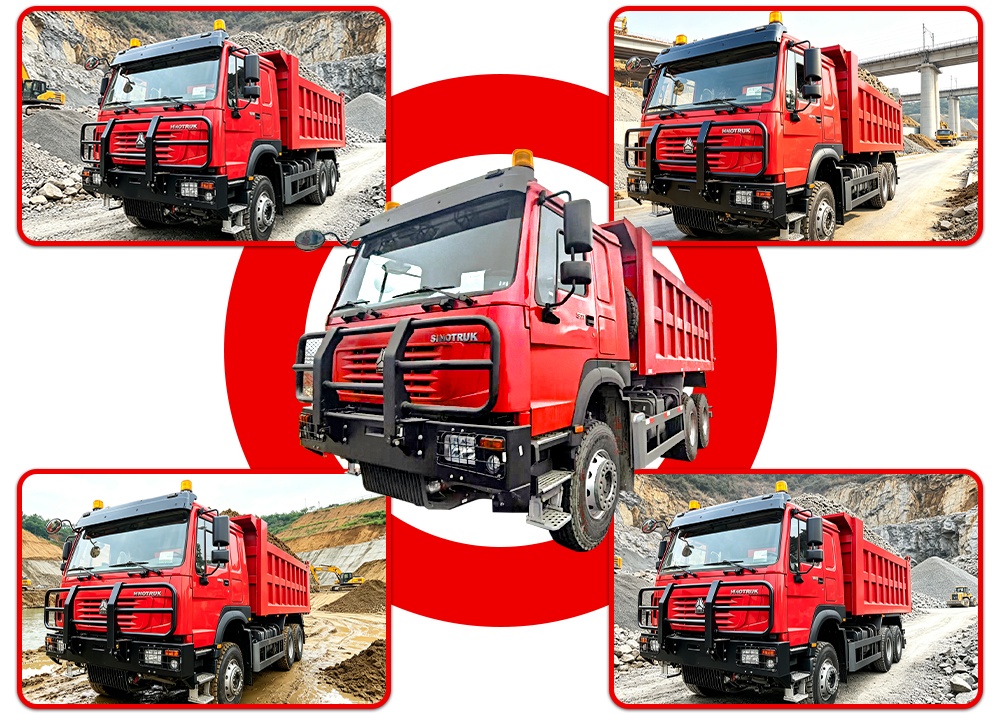
What African Mine Sites Demand from a Dump Truck
The operating conditions at mine sites are among the most demanding that any truck will face. Understanding these conditions explains why the trucks that succeed in mining are built the way they are.
Unpaved and deteriorating haul roads. Inside an open-pit mine, haul roads are unpaved, frequently graded but rarely smooth, and subject to rapid deterioration during rainy seasons. Trucks operate on these surfaces fully loaded, repeatedly, all day. It is not a question of occasional rough terrain — it is the permanent operating environment.
Sustained steep gradients. Open-pit mines require trucks to climb out of the pit under load, often on long, continuously graded ramps. This places sustained high demand on the engine, the drivetrain, and the braking system. Trucks that operate on flat highways are simply not stressed the same way.
Heavy impact loading. In most African mining operations, trucks are loaded by large excavators dropping rock into the body from height. This is not gentle loading. The body floor and the chassis absorb repeated impact forces that a road-going tipper never experiences.
Abrasive and dense materials. Ore, rock, and overburden are abrasive and heavy. The material wears the body quickly and, being dense, leaves less margin between a "full" body and an overloaded one. Body volume and steel thickness must be matched to the material being hauled, not chosen by habit.
High ambient temperatures and dust. In many mining regions, daytime temperatures are high year-round and dust is constant. Cooling systems must be sized for the climate, and air filtration maintenance becomes a critical daily discipline rather than a periodic task.
Remote locations and long parts lead times. Many mine sites are far from major cities and further still from established parts networks. A truck that cannot be repaired promptly is a truck that idles while its replacement parts make their way — often from overseas.
How These Conditions Shape the Right Truck Specification
Each of the operating conditions above translates into a specific specification requirement:
| Mine Site Condition | Specification Response |
|---|---|
| Steep pit ramps under load | High torque at low RPM; multi-speed gearbox (10–12 forward gears); double-reduction or hub-reduction drive axles for torque multiplication |
| Soft, unstable, rain-affected ground | 8×4 configuration for greater ground contact and traction; differential locks where available |
| Heavy impact loading by excavator | High-strength, thick-plate cargo body (heavy bottom and side thickness); reinforced double-layer chassis |
| Abrasive, dense material | Wear-resistant high-tensile steel body; body volume matched to material density to prevent overload |
| High ambient temperature and dust | Heavy-duty cooling package; frequent air filtration service; robust cooling system capacity |
| Remote location, long parts lead times | Widely deployed engine and gearbox platforms with broad parts availability; local stock of high-wear consumables |
Where Heavy Dump Truck Demand Is Concentrated
While mining activity spans the continent, demand for heavy dump trucks clusters around the regions where large-scale extraction is concentrated. Different regions also tend to favour different truck configurations.
Central and Southern Africa (copper and cobalt belts): Large open-pit operations with long haul ramps and high daily tonnage targets. These sites typically favour 8×4 dump trucks with high-strength bodies for continuous heavy haulage, and increasingly specify trucks built to handle deeper pits and longer haul distances.
West Africa (gold and other minerals): Both open-pit and underground operations. Open-pit sites require dump trucks for ore and overburden haulage; the supporting infrastructure and road-building work generates additional demand for tipper trucks.
East and Southern Africa (coal, iron ore, and quarry aggregate): Quarry and open-pit operations supplying both export markets and local construction demand. Quarry work in particular is abrasive and places heavy demands on body durability.
Pan-African infrastructure support: Mining expansion is accompanied by road, rail, and port development. This generates construction-material haulage demand that is closely related to — and often delivered by the same fleets serving — mining operations.
Fleet Strategy for Mining Operators
Mining fleets face a distinctive set of procurement challenges. Several practices have become common among operators equipping for African mining work:
Standardise on a proven platform. Where a fleet runs multiple truck models from different manufacturers, each one requires its own stock of spare parts, its own maintenance procedures, and its own training for mechanics. Standardising on a single proven platform — or at most a small number — simplifies parts inventory, reduces technician training burden, and lets the fleet build genuine maintenance expertise. In remote locations, this discipline is worth more than any marginal technical advantage a mixed fleet might offer.
Specify body volume to the material. A common cause of premature truck failure in mining is overloading: a body sized for light aggregate filled with dense ore exceeds the intended payload. Bodies should be sized to the material's density, and the resulting payload checked against the chassis and axle ratings.
Stock high-wear consumables on site. Filters, brake components, and hydraulic parts are consumed steadily under mining conditions. Holding a modest stock at the site — rather than ordering each part as it is needed — converts a weeks-long wait into a same-day repair. The carrying cost is modest compared to the cost of a truck standing idle.
Plan for mid-life rebuild rather than replacement. Mining trucks accumulate operating hours quickly. A structured rebuild programme — engine overhaul, chassis refurbishment, body replacement or repair — can extend service life substantially compared with buying a new truck each time the vehicle reaches its first major rebuild point. This approach also keeps the fleet working while new units are on order.
Buy parts support along with the trucks. Before ordering, confirm the availability of spare parts and technical support in the destination country. For widely deployed engine and gearbox platforms, parts and service knowledge are available well beyond any single dealer network. This is a practical question for the buyer to research, not an assumption to make.
The Outlook
As long as African mining activity continues to expand, the demand for heavy dump trucks will expand with it — because mining is fundamentally a materials movement business, and dump trucks are how the material moves. The trucks that succeed in this market are not necessarily the newest or most advanced. They are the ones engineered for the conditions at site: strong torque delivery for pit ramps, robust traction on soft ground, bodies and chassis built to survive impact loading, and — critically — parts and service support that keeps them working in remote locations.
For fleet operators equipping for mining work, the practical conclusion is straightforward. Define the site conditions first — road surfaces, gradients, material type and density, loading method, temperature, and distance from parts supply. Then specify the truck to match, rather than choosing a model and hoping the site suits it. The mines that run on schedule are the ones whose equipment was chosen for the work it actually does.
For specifications, configuration options, and delivered pricing on HOWO 8×4 dump trucks, HOWO NX tipper trucks, and other heavy mining haulage vehicles, contact the Shandong Chengda Auto Sales team.