HOWO 6×4 vs 8×4 Dump Truck: Choosing the Right Axle Layout
The Basic Difference — One Axle, Two Very Different Trucks
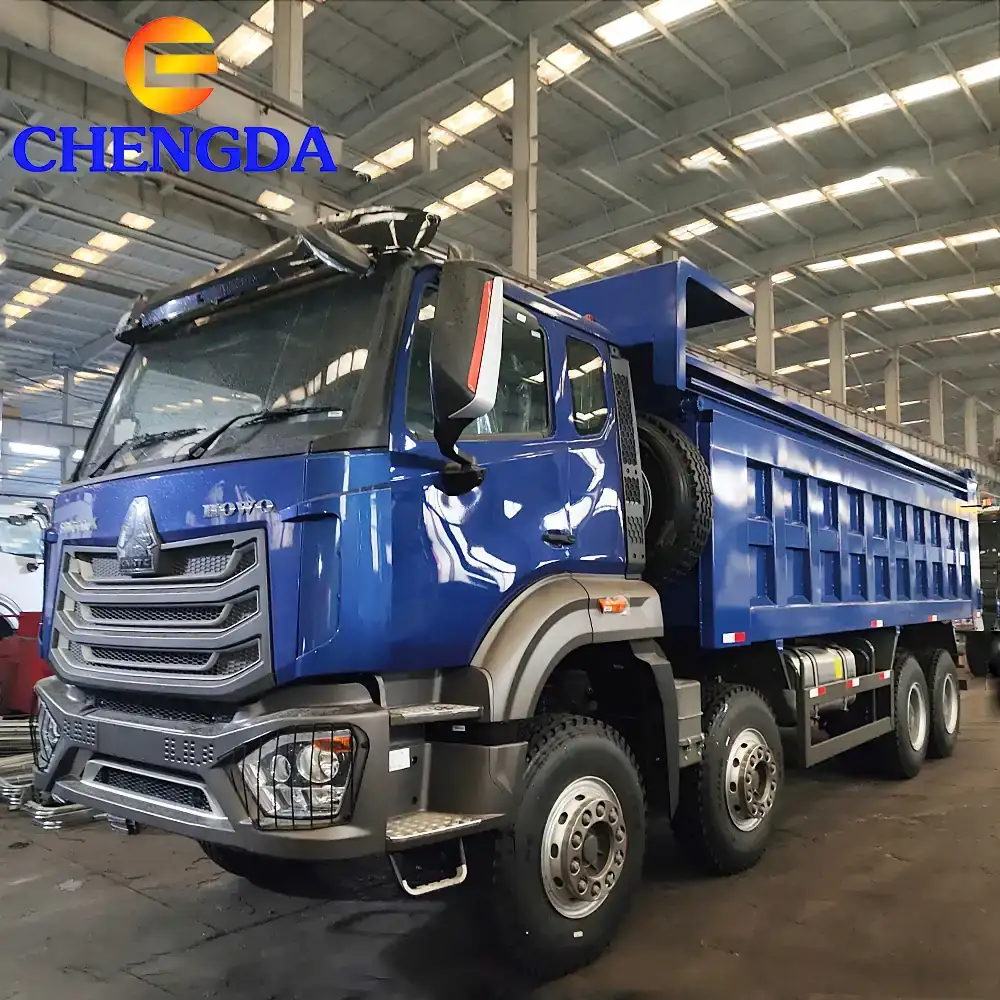
Both configurations are "wheel-end counted" the same way. A 6×4 has six wheel ends with four driven (tandem rear axles plus one steering axle up front) — a ten-wheeler. An 8×4 has eight wheel ends with four driven (tandem rear axles plus twin front steering axles) — a twelve-wheeler. The extra pair of wheels on the 8×4 sits at the front, sharing the steering and load-bearing duty between two axles instead of one.
That single structural difference drives everything else: how much weight the truck can legally carry, how it spreads load across the road surface, how stable it is on soft ground, and how much it costs to buy and run.
Side-by-Side Comparison
| Factor | HOWO 6×4 (10-Wheeler) | HOWO NX 8×4 (12-Wheeler) |
|---|---|---|
| Wheel ends / driven | 6 / 4 (one steering axle) | 8 / 4 (twin steering axles) |
| Typical engine options | 336HP / 371HP / 400HP (WD615 or Weichai) | 400HP (Weichai WP10.380E22 or equivalent) |
| Transmission | HW19710, 10 forward + 2 reverse | Fast 10/12-speed, matched to engine |
| Front axle capacity | Single steering axle (typically ~7.5T class) | 9.5T capacity |
| Drive axle capacity | HC16 / AC16 16-ton axles | 16-ton rear axles |
| Cargo box (reference) | 18–22 m³, Q345B, 8mm bottom / 6mm sides | 7,400 × 2,300 × 1,500 mm, high-strength steel |
| Overall dimensions (reference) | 8,500 × 2,500 × 3,450 mm | 9,735 × 2,490 × 3,790 mm |
| Wheelbase (reference) | Standard 6×4 layout | 1,800 + 3,575 + 1,400 mm |
| Fuel tank | Standard spec | 300 L |
| Tires | 12.00R20 or 12R22.5 (10 + 1) | 12.00R20 |
| Delivery lead time | Varies by configuration | 20–30 days |
Note that the two trucks carry the same nominal drive-axle rating — 16 tons per axle. The difference is at the front and in the overall footprint.
Where 6×4 Wins
Lower Purchase and Running Cost
An 8×4 costs more to buy than a 6×4 with comparable specification — extra axle, extra wheels, extra braking components, larger frame. It also carries more unladen weight, which means slightly higher fuel consumption for the same payload. For operations where the 6×4's payload capacity is sufficient, the 8×4 adds cost without adding productive capability.
Better Maneuverability
Two steering axles make an 8×4 harder to turn in tight spaces than a single-steering-axle 6×4. On cramped urban demolition sites, in narrow quarry access roads, or in confined loading yards, the 6×4's tighter turning behavior is a practical advantage. The 8×4 is longer overall (9,735 mm vs 8,500 mm in the reference specs above) and needs more room to complete a turn.
Right-Sized for Most Civil and Urban Work
For sand, gravel, crushed concrete, and general earthmoving on civil infrastructure projects, and for urban demolition debris clearance, the 6×4's payload capacity is typically adequate. The HOWO 371HP 6×4 with its 18–22 m³ cargo box is a well-established configuration for exactly these applications — which is why it remains the most widely deployed HOWO dump truck globally.

Where 8×4 Wins
Higher Legal Payload
The 8×4's twin front axles allow it to spread more weight legally. With a 9.5-ton front axle capacity and twin steering axles, the truck can carry a heavier total load within general axle-weight limits — making it the configuration of choice when the goal is maximum tonnage per trip. For mining operations where daily tonnage targets drive profitability, this is the decisive factor.
Superior Traction and Stability on Soft or Steep Ground
On rain-soaked haul roads, soft overburden, and steep unpaved grades, the 8×4's extra front wheels provide more ground contact and better weight distribution. When a 6×4's single front axle starts to sink or lose steering authority on soft ground, the 8×4's twin front axles keep the truck tracking straight and steering predictably. This is the reason 8×4 trucks dominate mining and quarry operations in challenging terrain — the configuration exists precisely to solve this problem.
Better Suited to Abrasive, High-Impact Loading
Mining sites load with large excavators dropping heavy rock into the body. The 8×4's larger footprint and heavier frame distribution absorb these shock loads more comfortably than a lighter 6×4 platform. The HOWO NX 8×4's high-strength steel dump body (7,400 × 2,300 × 1,500 mm) is specified for repeated excavator loading without deformation — a requirement that reflects the truck's intended duty.
Matching the Layout to the Job
Choose 6×4 if:
Your routes are mostly paved or firm-graded surfaces
Site access involves tight turns, narrow roads, or restricted loading yards
Your payload requirement fits within 6×4 legal limits for your market
Purchase cost and fuel economy are primary considerations
You run general civil earthmoving, urban demolition, or aggregate distribution
Your loading equipment is sized to match a 6×4 body volume (18–22 m³)
Choose 8×4 if:
You operate open-pit mining, quarry, or heavy overburden haulage
Haul roads are unpaved, steep, and frequently soft or rain-affected
Maximum legal payload per trip is the key profitability driver
You load with large excavators delivering heavy, abrasive material
Your site has the space for a longer, twin-steering-axle vehicle to maneuver
Your axle-weight limits reward spreading load across more axles
Common Ground — What Both Share
Whichever layout you choose, HOWO dump trucks share several platform characteristics that matter for fleet planning:
Hydraulic tipping system: Front-lifting or middle-lifting cylinders, selected for stability under uneven ground conditions. Confirm which option suits your site drainage and ground firmness.
Reinforced double-layer chassis: High-strength steel frame construction designed for continuous high-impact loading cycles.
Multi-leaf spring suspension: Heavy-duty leaf springs on the drive axles for load-bearing durability on rough surfaces.
HW-series manual transmission: Synchronized gearboxes matched to engine power curves for efficient torque delivery on grades.
HW76 sleeper cab option: Air-suspended driver seat, climate control, and an ergonomic dashboard layout to reduce driver fatigue on long shifts.
Dual-circuit air brakes with ABS: Standard on both configurations — non-negotiable for trucks operating at gross weight.
What to Confirm Before Ordering
Cargo box volume and steel thickness matched to your material density and loading method
Engine rating — 336HP / 371HP / 400HP — matched to the axle layout you choose
Hydraulic lifting type (front-lift vs middle-lift) for your ground conditions
Tire specification — 12.00R20 or 12R22.5 — and availability in your market
Legal axle weights and gross vehicle weight limits in the destination country
Left-hand-drive or right-hand-drive configuration
Cargo box customization — volume, steel grade, and compartment layout
Warranty scope, spare parts support, and delivery terms (FOB / CFR / CIF)
Conclusion
The 6×4 versus 8×4 decision is not about which truck is "better" — it is about which layout matches your site, your material, your loading equipment, and your legal payload limit. The 6×4 is the economical, maneuverable workhorse for civil construction, urban demolition, and aggregate haulage on firm ground. The 8×4 is the heavy-payload solution for mining, quarry, and overburden haulage where traction, stability, and maximum legal tonnage determine whether the operation is profitable. Match the axle layout to the job, and either configuration will deliver the service life that has made HOWO the most widely exported Chinese heavy truck platform.
For specifications, cargo box customization, and delivered pricing on HOWO 6×4 and 8×4 dump trucks, contact the Shandong Chengda Auto Sales team.